Posts

Abstract for Belichick, McDaniels, and Patricia (2016)

My early assessment of the Tom Brady suspension as a natural experiment to examine the classic QB vs. system debate. pic.twitter.com/DwzFkyk5g9 — Alex Garlick (@garlicksauce) September 23, 2016

UPDATE: I defeated Donald Trump

Image
On Monday, I wrote about my plan to strategically vote against Trump on Super Tuesday . As with many things political scientists say, it was a decision based in reason that I did not expect much to come of. When I got to the polling place, I was asked which ballot I wanted, and it was somewhat surreal to hear myself say: "Republican." I could feel JFK spinning in his grave. I got into the voting booth and found myself face to face with this: a genuine Republican primary ballot. I went through with the plan, and voted for John R. Kasich of Ohio (I did laugh at the idea of supporting Jeb!). On my way out I pledged to re-read Profiles in Courage  to make it up to JFK. This morning, the results show that my single strategic vote won Hartford, Vermont for John Kasich. And statewide, Kasich played Trump to a tie, as they will split Vermont's 12 GOP delegates.  Not to call myself a hero, but this morning my neighbors woke up in a town that does not support...

Why I’m voting in my first Republican primary.

Image
Tomorrow, Super Tuesday, is the presidential primary in my new state of Vermont. It is also the first day I will ever vote in a Republican primary. I am doing this because: 1) I can, 2) I care about my country, 3) it’s strategic. Why? 1. I can.  Vermont is one of 11 states that has an “Open Primary”, meaning a voter can choose to vote in either party’s primary. My understanding is that Vermont voters are handed two or more ballots and instructed to just fill out and deposit one of them. This encourages strategic voting. 2. I care about the tenor of politics in this country. I will be voting in the Republican primary to vote against Donald Trump. Trump is probably more moderate than his main competitors, Marco Rubio and Ted Cruz, but ideology is not everything. The lack of civility that Trump brings to politics is unhealthy. While many have lamented the state of affairs in Congress, electing Donald Trump would not fix anything. Just look at Maine, which elected ...

A GIF Overview of Party Labels on Ballots

Image
Last spring, I made a GIF about the history of the Australian Ballot in the United States ( here ), when I was presenting my research as a manuscript at the MPSA conference. Today, that manuscript was published as an article in State Politics and Policy Quarterly ( my first peer-reviewed article!). Therefore, it's time for another GIF. This one goes over a few top-line results from the paper. BONUS: You can read the article on my academic website .

My OP-ED in US News

Image
US News published my OP-ED about the use of gridlock as a tactic in Congress. Feel free to give it a read! The GOP obstructs legislation because, well, it works http://t.co/dXLXRfS4GP — U.S. News Opinion (@USNewsOpinion) December 2, 2014

Projection: The Six-Year Itch and A Rainy Day for Democrats

Image
538's projection likes the Republicans even more. After nailing the projection for the 2012 election ( well, almost ) and the 2010 Special Election ( see the section on Scott Brown losing in 2012 ), I’ve spent hours in the lab preparing this prediction. And… it’s not pretty for Democrats. The US Senate Projection : Republicans finish with 51 seats, take control of the Senate. If you recall from 2012, I emphasized how important the economy was for national elections. In short, a good economy is good for the incumbent party in the White House (this is why I projected an easy win for Obama). Since then the economy has continued to improve, with the unemployment rate down to 6%. Why is it going to be bad for the Democrats then? Two things: The economic gains are not being equally distributed. The NY Times shows how benefits from the recovery have flowed disproportionately to top earners. And this is not just the famed “1%”, the unemployment rate is 6% nationwide but...

Turnout for What?: An altogether different concern with field experiments

Image
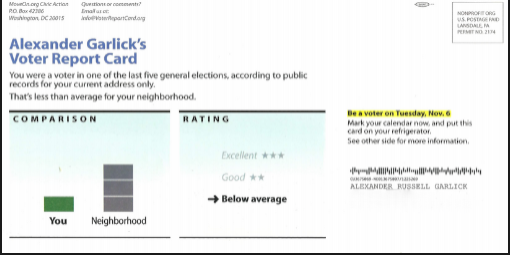
To the degree that Political Science Twitter can blow up, it blew up this week with the controversy over a field experiment run by professors at Stanford and Dartmouth in Montana (For the latest in the debate, see John Patty ; for overview, Derek Willis in NYT ). I don’t have anything to add to the ethics in field experiments discussion, although I am sympathetic to the accused profs. (If you would like a totally ethical look at how information increases participation in races like these, see my MPSA paper from last year!) My concern with this episode is that it illustrates a problem with the literature on turnout studies. They’ve gotten too good. One only needs to look around at the mail parties send to voters to see that voter shaming ( like in Alaska ), and possibly intimidation, is alive and well. These are techniques that were first tested by field experiments. (Look, it even happened to me in 2012) The combination of these techniques and the robust field offi...