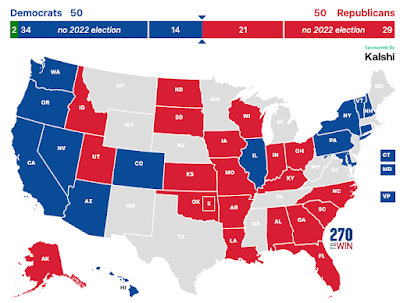
I don't know why I'm still writing these, it's mostly just to torture myself after getting the vibes of both 2024 and 2022 wrong. But it serves as a reminder of how difficult the projection business is. For 2026, the polls have been good for Democrats. So good that we're heading for either one of two scenarios: 1) a Democratic wave, 2) ANOTHER massive polling error (that underestimates Republicans) of which we've had two in the Trump era (2016 and 2020, notably when Trump himself is on the ballot).
I'm going to go with #1, and assume the pollsters are mostly correct, for one methodological reason and one theoretical reason. Methodologically, Trump is not on the actual ballot and even the output of the 2024 polls was not catastrophically bad. Having been trained on how polls used to be (the golden era of random digit dialing), I admit that I'm not comfortable with how much modern polling is engineered (recruiting respondents online or via SMS and then heavily weighting the samples, including using recalled vote choice), but it's the best we have in this media environment. And while the polls didn't predict a clear Trump victory (see my 2024 prediction below), it was not an enormous miss, and nearly all the aggregators had that as a 50:50 race and it happened to go to Trump by about 1.5 percent. And many of the other statewide elections (notably MI, AZ, NV Senate) went to the Democrats, so it wasn't a wipeout.
Theoretically, the fundamentals are bad for Republicans. Let me just update my pessimistic take about the 2022 Democrats.
I think this is going to be an ugly election cycle for the Democrats Republicans. We can expect losses for the president's party in Congress in their first any midterm election, and Joe Biden Donald Trump has not done anything to change my expectation. This is compounded by the fact that the economy seems to be the most pressing concern for voters, and inflation is a very difficult issue for policymakers to make go away or minimize. Since inflation is effectively making money less valuable, people that have a lot of money hate it, and even though unemployment is at a record low right, and many people in lower tax brackets have money in their pockets, it doesn't seem to go as far when you have to pay large bills for gas, heating your home or buying groceries.
Crazy how turbulent the 2025 national politics were while so much else stay the same. Now, that was not a good projection because Democrats overperformed expectations in that election (although that maybe led to the cursed decision of Biden to run again in 2023-24 after he pledged to be a "bridge" candidate). I consider that overperformance to be: changes in the coalitions, with Democrats adding more high education voters with higher turnout propensity in midterms, and also how the most notably policy during the first two years of Biden's term was the unpopular Dobbs decision that overturned Roe v. Wade. Since the Supreme Court made that decision, voters didn't hold it against Biden and may have even been motivated to vote.
The issue the Republicans have right now is that the two of the most significant policy decisions Trump has made: tariffs and going to war in Iran, have both been inflationary. So Democrats can tie the unpopular conditions on the ground now directly to Trump, and by extension congressional Republicans. Many other decisions Trump has made further complicate that calculus (holding a convention was probably the last thing he should've done), but fundamentally the biggest issue is the economy and this is the first time in the Trump era he's had to defend a bad economy.
So I expect the Democrats to comfortably take the House. It probably won't be by the record margins of Clinton losing 64 seats in 1994, or Obama's Democrats losing 69 in 2010, but could approach Trump's Republicans losing 40 in 2018. I don't think it will reach those record highs because there's not a ton of low hanging fruit for Democrats considering they already have about 214 seats, and because several red states (particularly Florida) gerrymandered their districts before this election. I will be watching the gerrymandered seats in Texas closely, as there's a chance Texas Republicans (at Trump's behest) got a little too cute with drawing districts that were Trump +10 in 2024.
As for the Senate, here's the call. In line with my tepid belief in the polls I think the Democrats can have a very good night, winning seats they usually wouldn't have a chance at in Iowa and Kansas. These states have been particularly exposed to the diesel fuel price crisis created by the war. The most notable of these flips could be Texas, which is a function of both the national environment and Trump's pick of Ken Paxton. If this race is as tight as the polls indicate it makes you wonder if Trump had stayed out of it and allowed John Cornyn to have the nomination it would probably have been a hold, and still could be! But James Talarico seems ascendant despite Elon Musk putting $ 0.3 billion in the state.
I also think the Democrats have a great trio of candidates for the moment in North Carolina (with Cooper) and Georgia (with Ossoff) and perhaps even in Ohio (Sherrod Brown is a strong candidate with a history with voters). Peltola in Alaska is a hard call, but I'll go with that one on the vibes alone. The lone blemish I see for Democrats is Susan Collins in Maine, like Brown she has a long history with Maine voters that I think can transcend the bad national environment for Republicans. Also, Democrats switched their candidate midway through the cycle and that's never a good sign. I'm also willing to trust the polls on MI, NH and MN.
Finally for Governors, it's probably also a good cycle to be a Democrat. In particular Amy Acton in Ohio and Rob Sand in Iowa are two places Democrats will be thrilled to get the governor's mansions. Also Alaska.
I think the Democratic wave will likely crest beneath Texas and Florida though were Abbott and Donalds hold crucial governorships for the Republicans. Abbott doesn't have the same issues as Paxton.
Finally here in New England, Maura Healey should be fine in Massachuestts (it's not great that her opponent Mike Minogue's pitch to voters is that the first thing he'll do is fire his Lt. Governor who is on the ticket with him), as well as Chellie Pingree in Maine. Kelly Ayotte looks primed to hold her seat in New Hampshire, as this tweet indicates:
We're left with Vermont. Polling data is sparse, so we're going off vibes and yard signs here. Amanda Janoo, the Democratic/Progressive nominee, has far outpaced expectations winning the primary from out of nowhere (which I didn't think she would do) and even leading 5-term incumbent Phil Scott in a poll or two. I've been very impressed with her personally, we hosted her at UVM this week and she is a magnetic speaker and is very willing to introduce fresh ideas in a state that is thirsty for them. I took this photo this week that captures a hopeful dynamic for Janoo, that it becomes a landlords vs. renters (with homemade signs) race.

In Burlington you can win with renters over landlords, but I'm not sure that's the case state wide. Janoo has poked the bear in Phil Scott and he's rallied his moderate troops. While Janoo has taken advantage of local anger at Phil Scott for his plans to consolidate under-enrolled school districts, the #1 concern of the day is affordability and Janoo is talking about increasing taxes on high earners. That dyanmic puts Phil Scott exactly on the terrain where he excels: criticizing liberal tax-and-spend progressives when property taxes increases have been high. So while I expect this to be the closest governor race since 2016 I don't think Janoo has done quite enough to take Scott out.